
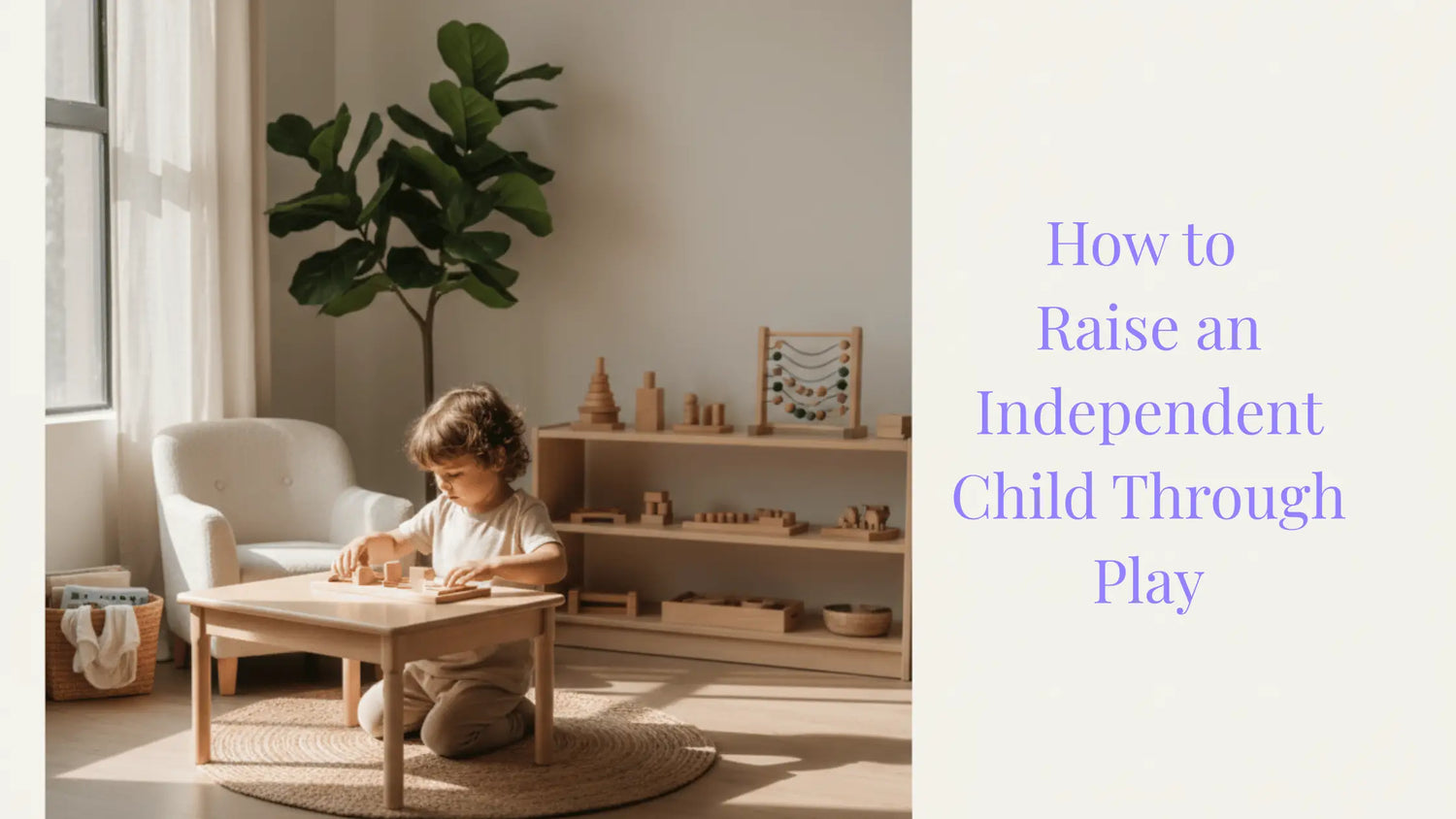
Every parent has been there. You hand your child a puzzle and walk away for thirty seconds — and they're already calling for you. You set up an activity, and the moment it gets slightly challenging, they look to you to solve it. It can feel like independence is something some children just have, and others don't.
But here's what Maria Montessori understood more than a century ago, and what child development research confirms today: independence is not a personality trait. It is a skill. And like any skill, it is built through practice — specifically, through the right kind of play.
Help me do it by myself. — Maria Montessori
Why Independence Matters More Than You Think
We often think of independence in practical terms — a child who can put on their own shoes, pour their own water, clean up their own toys. And yes, those things matter. But the deeper benefit of raising an independent child is internal: it builds self-trust.
When a child learns that they can figure things out — that mistakes are part of the process, not the end of it — they develop what psychologists call intrinsic motivation. They stop playing for your approval and start playing for the pure joy of discovery. They become children who try. Children who persist. Children who grow into adults who believe in their own capabilities.
The Montessori method is built on this insight. Rather than guiding children step by step toward a predetermined outcome, it creates environments and provides materials that invite children to act, explore, and self-correct — on their own timeline.
The Problem With Most Toys
Walk through any toy aisle and you will notice something: most toys are designed to do things for children. Buttons that play music. Apps that animate the story. Toys that light up, talk, and reward every interaction with a satisfying sound.
These toys are not bad — but they quietly teach a lesson that works against independence. They tell the child: sit back, press a button, and be entertained. The toy does the work. The child is the audience.
Montessori materials work on the opposite principle. They are intentionally simple. They invite the child to act — and they are designed so the child can discover whether they succeeded without needing an adult to tell them. This is called the control of error and it is one of the most powerful features of true Montessori design.
A puzzle piece that does not fit tells the child it does not fit — no adult needed. A stacking tower that topples shows the child their sequence was off. The toy itself gives the feedback. That is independence in action.
5 Ways to Encourage Independence Through Play at Home
1. Choose open-ended toys
Open-ended toys — building blocks, stacking cups, shape sorters, balance boards — have no single correct outcome. The child decides how to use them. This is deeply important because it means the child is always the one leading. There is no right answer they can get wrong. There is only exploration.
2. Resist the urge to help immediately
When your child struggles with an activity, the instinct to jump in is powerful. Try waiting 60 seconds before intervening. Watch their face — often, what looks like frustration is actually deep concentration. Children who are allowed to wrestle with a challenge and solve it themselves experience a rush of pride that no amount of praise can replicate.
3. Create a yes environment
Independence flourishes when children can access their environment freely. Consider setting up a low shelf with a small rotation of toys they can reach themselves. When a child can choose their own activity, set it up, and put it away — that entire cycle is an exercise in self-management.
4. Let them do real things
Children do not distinguish between play and real life the way adults do. A toy kitchen is meaningful — but so is stirring the soup, folding a small towel, or watering a plant. Practical life activities build independence faster than almost anything else because they teach children that they are genuinely capable contributors to the household.
5. Rotate toys intentionally
Too many choices overwhelm children and lead to shallow, scattered play. Try offering 5 to 8 items at a time and rotating them every week or two. Fewer toys leads to deeper engagement — and a child who plays deeply with one toy is practicing exactly the kind of focused independence that Montessori is built on.
A child who has never learned to work independently, to rely on their own efforts, lacks one of the finest qualities that education can give.
The Role of the Parent: Guide, Not Director
One of the hardest parts of the Montessori approach for parents is stepping back. We are conditioned to teach, explain, demonstrate, and correct. But in a Montessori environment, the adult role is to prepare the space and then get out of the way.
This does not mean being absent. It means being present without interfering. Observe. Notice what your child gravitates toward. Notice where they get stuck — and ask a question rather than giving an answer. What do you think would happen if you tried it the other way? is worth a thousand demonstrations.
This shift — from director to guide — is one of the most transformative things a parent can do. Not because it changes your child, but because it signals to them: I trust you to figure this out. And children who feel trusted, rise to it.
A Final Thought
Growing up, I did not have many toys. Resources were limited and creativity was the currency we worked with. What I learned — and what I want every child who discovers Seaside Montessori to experience — is that the best play is the kind where the child is the engine.
The toy is just the invitation. Independence is what happens when you trust your child enough to answer it on their own.
Shop our Activity Toys and Home and Living collections — designed to invite independence at every age and stage.


Leave a comment
All comments are moderated before being published.
This site is protected by hCaptcha and the hCaptcha Privacy Policy and Terms of Service apply.